If you’ve ever walked through a warehouse that feels like it’s built for tight corners, stacked shelves that barely leave room to turn around, and aisles where even a standard hand pallet truck feels too wide to navigate easily, you’ve probably wondered: can an electric pallet truck actually work in those narrow spaces? As a supplier of electric pallet trucks, I get this question all the time, and it’s one that comes with a lot of nuance—way more than just a simple “yes” or “no.” Over the past decade, I’ve worked with hundreds of warehouse managers, distribution center supervisors, and even small shop owners who’ve had to balance two big needs: moving heavy loads efficiently without slowing down operations, and making the most of every inch of space they have. Let me break this down, not just as a vendor, but as someone who’s seen first-hand how the right electric pallet truck can completely transform a narrow aisle operation. Electric Pallet Truck
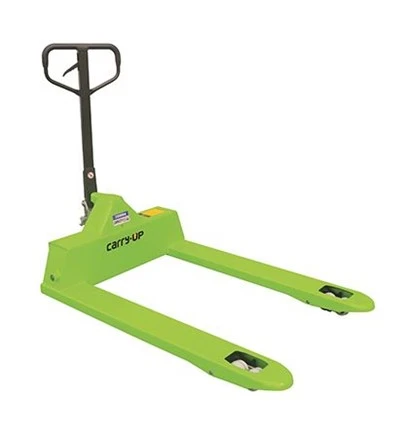
First, let’s start with what people usually mean when they say “narrow aisle.” A lot of folks assume narrow aisle is just any space smaller than, say, 12 feet, but that’s not the whole story. I’ve seen aisles as tight as 5 feet (common in small retail backrooms or cold storage facilities where space is premium) up to 10 feet, which is often the sweet spot for many mid-sized warehouses. The problem with traditional electric pallet trucks—wait, let’s be clear: I’m not talking about the old, bulky models you might see at a big-box store that take up half the aisle when turning. Those are designed for general use, not confined spaces. But today’s modern narrow-aisle electric pallet trucks are built from the ground up to address that exact gap.
Let’s talk about the key design features that make this possible, because that’s where a lot of the confusion comes in. A standard electric pallet truck has a wheelbase (the distance between the front and rear wheels) that’s usually around 40 inches, plus a fork width that’s roughly 27 inches wide. For a standard 8-foot aisle, that leaves about 3 feet of space on either side—plenty, but if you shrink that aisle to 6 feet, suddenly that space disappears, and you can’t turn without hitting shelves. Narrow-aisle electric pallet trucks, though, have a much shorter wheelbase, sometimes as little as 30 inches, and a compact chassis that doesn’t stick out past the forks when turning. That’s a game-changer, because it means the turning radius is drastically smaller—some models have a turning radius of less than 50 inches, which lets you maneuver in an aisle that’s only 5.5 feet wide. I had a customer last year who ran a 10,000 square foot e-commerce fulfillment center in downtown Chicago; their aisles were originally 7 feet wide, and they were wasting 20% of their storage space because they couldn’t stack pallets closer. When we switched them to our narrow-aisle electric pallet trucks, they were able to shrink aisles to 6 feet, add 15% more pallet positions, and still keep operations running at full speed.
But it’s not just the turning radius. Another big factor is the truck’s ability to handle load weight without being bulky. A lot of people worry that a narrow electric pallet truck can’t lift or carry as much as a standard model, but that’s a myth for most light to mid-heavy loads. Our narrow-aisle models can handle loads up to 5,500 pounds, which is more than enough for standard wooden pallets, plastic pallets, and even some racked pallets used in small warehouses. For context, a standard grocery pallet of canned goods weighs around 4,000 pounds, so that’s well within capacity. The weight savings from the compact chassis—most narrow models weigh around 1,800 pounds, compared to 2,500 pounds for a standard electric pallet truck—also means there’s less pressure on warehouse floors, which is a big deal for older facilities with concrete that’s starting to crack. I’ve had customers in historic downtown warehouses (think 100-year-old buildings with original floors) who told me standard trucks were causing small cracks to widen, but our narrow models, with their lower overall weight, eliminated that problem.
Wait, but what about very narrow spaces—like 5-foot aisles? Can you really use an electric pallet truck there? That’s a question I get from cold storage operators and small craft breweries, where aisles are often designed for manual hand trucks, but they want to upgrade to electric to reduce worker fatigue. The short answer is yes, but you have to pick the right model, and you have to adjust how you operate. There are ultra-narrow electric pallet trucks with a side-stance operator design, meaning the driver stands sideways on the truck instead of facing forward, which cuts the overall width of the truck by nearly half. These are designed for aisles as small as 4.5 feet, and they’re perfect for picking up single pallets or even moving individual cases along very tight aisles. I worked with a craft brewery in Portland last year that had a 4.8-foot aisle between their fermenting tanks and their storage racks; they were using manual hand trucks that required two workers to move a single pallet, and it was slowing down their bottling line. We supplied them with a side-stance narrow electric pallet truck, and now one worker can move two pallets in the same time, with no risk of hitting the tanks. The biggest adjustment they had to make was training their team to operate the side-stance model, but that took less than a day, and the productivity gain was immediate.
But it’s not all sunshine and tight turns. There are some limitations that people need to be aware of, because no electric pallet truck is a one-size-fits-all solution. For example, if you’re dealing with very heavy loads—over 6,000 pounds—or long pallets that stick out more than 48 inches, a narrow electric pallet truck might not be the best fit. The longer wheelbase needed for heavy loads means the turning radius increases, so you might need a 7-foot or wider aisle. Also, if your narrow aisles are shared with other equipment—like forklifts or order pickers—you have to make sure there’s enough space for two vehicles to pass. A standard narrow aisle of 6 feet might work for single-file use, but if you need to pull over to let another truck pass, you might need to add a foot or two. That said, most warehouses that use narrow-aisle electric pallet trucks design their aisles for single-file operation, with designated passing bays every 20 to 30 feet, which solves that problem.
Another common question is about safety. A lot of people worry that a smaller, more maneuverable truck is more likely to tip or cause accidents. Modern narrow-aisle electric pallet trucks are built with stability features that address this, like a low center of gravity, anti-roll back mechanisms, and automatic speed reduction when turning. I’ve seen the data from safety inspections at warehouses that use these trucks: the accident rate for narrow-aisle electric pallet trucks is actually lower than for manual hand trucks, because workers don’t have to push heavy loads across long distances, which reduces strain and fatigue. That’s a big deal, because worker fatigue is one of the top causes of warehouse injuries, according to OSHA. A manual hand truck can take 300 pounds of force to push a 4,000-pound pallet, which leads to back injuries and muscle strains, while an electric pallet truck requires almost no physical effort, so workers stay alert and less likely to make a mistake.
Let’s also talk about a common misconception: that narrow-aisle electric pallet trucks are more expensive than standard models. When you look at the upfront cost, they might be a few hundred dollars more, but the long-term savings are huge. Let’s do the math: if you’re a warehouse with 10 aisles, and you can shrink each aisle by 2 feet, that’s 20 extra feet of space, which can add up to 10 or more additional pallet positions. A single pallet in a warehouse that runs 24/7 can generate $500 a month in inventory, so 10 pallets is $5,000 extra monthly revenue. Over a year, that’s $60,000, which is way more than the difference between a narrow and standard electric pallet truck. Also, electric pallet trucks have lower operating costs than gas or diesel forklifts—they don’t need fuel, oil changes, or emissions testing, and they’re quieter, which is a big plus for indoor environments where air quality matters.
I’ve seen this play out time and again with customers who were skeptical at first. Take a small grocery chain in the Midwest that had 12 stores, each with a backroom aisle of 5 feet, using manual hand trucks. They were having trouble keeping up with restocking, and workers were calling out sick with back injuries every week. We supplied each store with two narrow electric pallet trucks, and within three months, worker compensation claims related to material handling dropped by 80%, and restocking time was cut by 40%. They didn’t have to expand their stores, which would have cost hundreds of thousands of dollars, they just used the space they already had more efficiently.
So, to circle back to the original question: Can an electric pallet truck be used in a narrow aisle? The answer is a resounding yes—but only if you choose the right model for your specific aisle width, load requirements, and operational needs. It’s not a matter of “will it fit?” but “which narrow-aisle electric pallet truck will fit your space?” That’s why as a supplier, I always start a conversation with a customer by asking a few key questions: How wide are your aisles? What’s the average and maximum load weight you move? Do you have other equipment sharing the aisles? What’s your primary use (restocking, order picking, pallet transport)? Those details help me point them to the right model, instead of trying to sell them something that doesn’t fit.
There’s no one-size-fits-all when it comes to warehouse equipment, but the days of thinking electric pallet trucks are only for wide, open spaces are long gone. Narrow-aisle models have evolved to address the specific challenges of tight spaces, and they offer a way to improve efficiency, reduce worker fatigue, and maximize storage space without the cost of expanding your facility. If you’re working with narrow aisles and you’re not sure if an electric pallet truck will work for you, I’d encourage you to reach out. We can walk through your space, your operations, and find the right solution that fits your needs, no matter how tight those aisles are.
Electric Pallet Truck References
- Occupational Safety and Health Administration (OSHA). 2022 Warehouse Safety Guidelines: Material Handling Equipment and Worker Fatigue Reduction. U.S. Department of Labor.
- Material Handling Industry (MHI). 2023 Narrow Aisle Equipment Market Report: Trends in Compact Electric Lift Trucks. MHI Global.
- National Council for Occupational Safety and Health (NCOSH). 2021 Back Injury Prevention in Warehouses: Electric vs. Manual Material Handling Tools. NCOSH.
- Warehouse Education and Research Council (WERC). 2022 Space Utilization in Modern Distribution Centers: Maximizing Storage in Confined Spaces. WERC International.
Hangzhou Carry Equipment Co., Ltd.
Hangzhou Carry Equipment Co., Ltd. is one of the most professional electric pallet truck manufacturers and suppliers in China, also supports customized service. Please feel free to buy advanced electric pallet truck for sale here and get quotation from our factory. For price consultation, contact us.
Address: No.360 Tongxiang Rd., Yinzhou Economic Development Zone, Yinzhou Dist., Ningbo, China
E-mail: Sales@carryupmhe.com
WebSite: https://www.carrymhe.com/
